

The product, in depth
From a learned policy to a different kind of controller.
EchoMotion explores soft-robot control through policy transfer and Echo State Networks. The research question concerns what happens after a policy has been learned: can that behaviour be represented by another controller, and how does that affect the CPU time needed to select an action?
The supplied demonstration interface gives the work a visual setting. A motion lab connects the robot morphology with an environment and a controller; an experiment library organises the example runs; and a comparison view explains the teacher, student and baseline approaches. The research and the interface can be explored as parts of the same technical story.
01 / The research question
Look at how the learned behaviour is put to work.
A trained policy is one part of a control problem. The software still has to use that policy to choose actions within the environment. EchoMotion investigates transferring policies trained with Proximal Policy Optimisation into Echo State Networks, connecting a learning method with a different representation of the controller. The work uses Python, EvoGym and Stable-Baselines3 as its technical setting for simulation-based soft-robot control.
The overview turns that question into a visible workflow: train a teacher, transfer the knowledge and compare the resulting behaviour. A voxel-based morphology gives the control problem a physical-looking frame of reference, while the adjacent chart and recent-experiment list connect the robot with the work being examined. The interface uses a shared robot representation to keep attention on how different controllers approach the same kind of movement.
02 / Policy transfer
Keep the controller and its environment in the same picture.
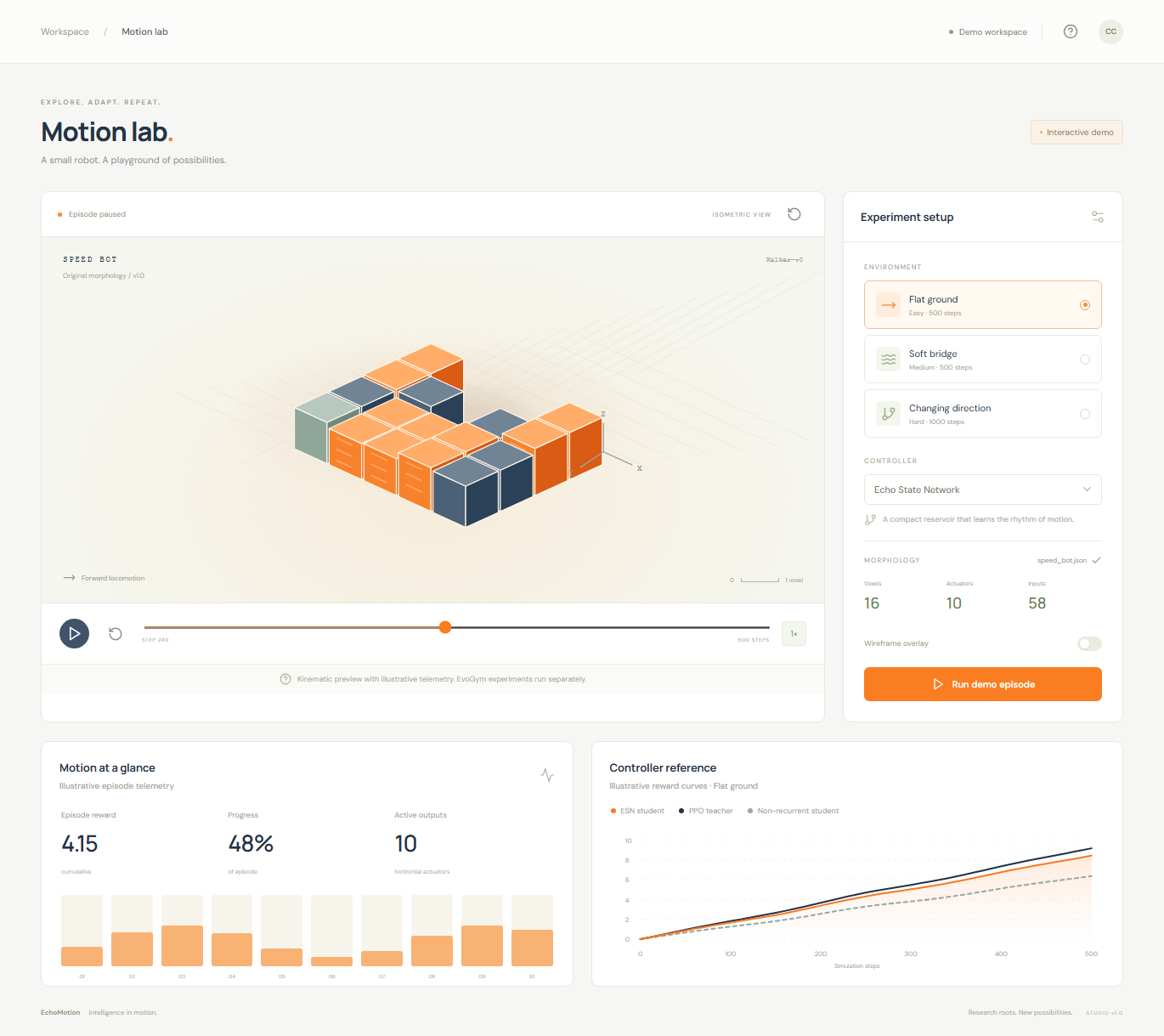
The motion lab connects the isometric robot view with an experiment-setup panel. Flat ground, a soft bridge and a change of direction give the demonstration three recognisable movement situations. The selected controller and morphology remain visible beside the scene, making the setup part of the explanation rather than something a visitor has to infer from an animation alone.
Playback controls, an episode-position slider and a wireframe option provide a structure for inspecting the demonstration. The lower panels place example progress, reward and actuator outputs alongside a controller-reference chart. Bringing setup, scene and telemetry together makes it easier to understand what a control experiment involves. The screen labels its kinematic preview and illustrative telemetry explicitly; the original EvoGym experiments run separately from that explanatory presentation.
03 / Controller comparison
Compare a defined part of the work.
EchoMotion's reported comparison concerns mean CPU action-selection time for an ESN controller relative to PPO under the tested conditions. The approximately 8.8-times figure is specific to that measurement. It does not describe total training time, physical robot speed or a general performance advantage across all controller designs. Keeping the measurement precise is what gives the result an interpretable meaning.
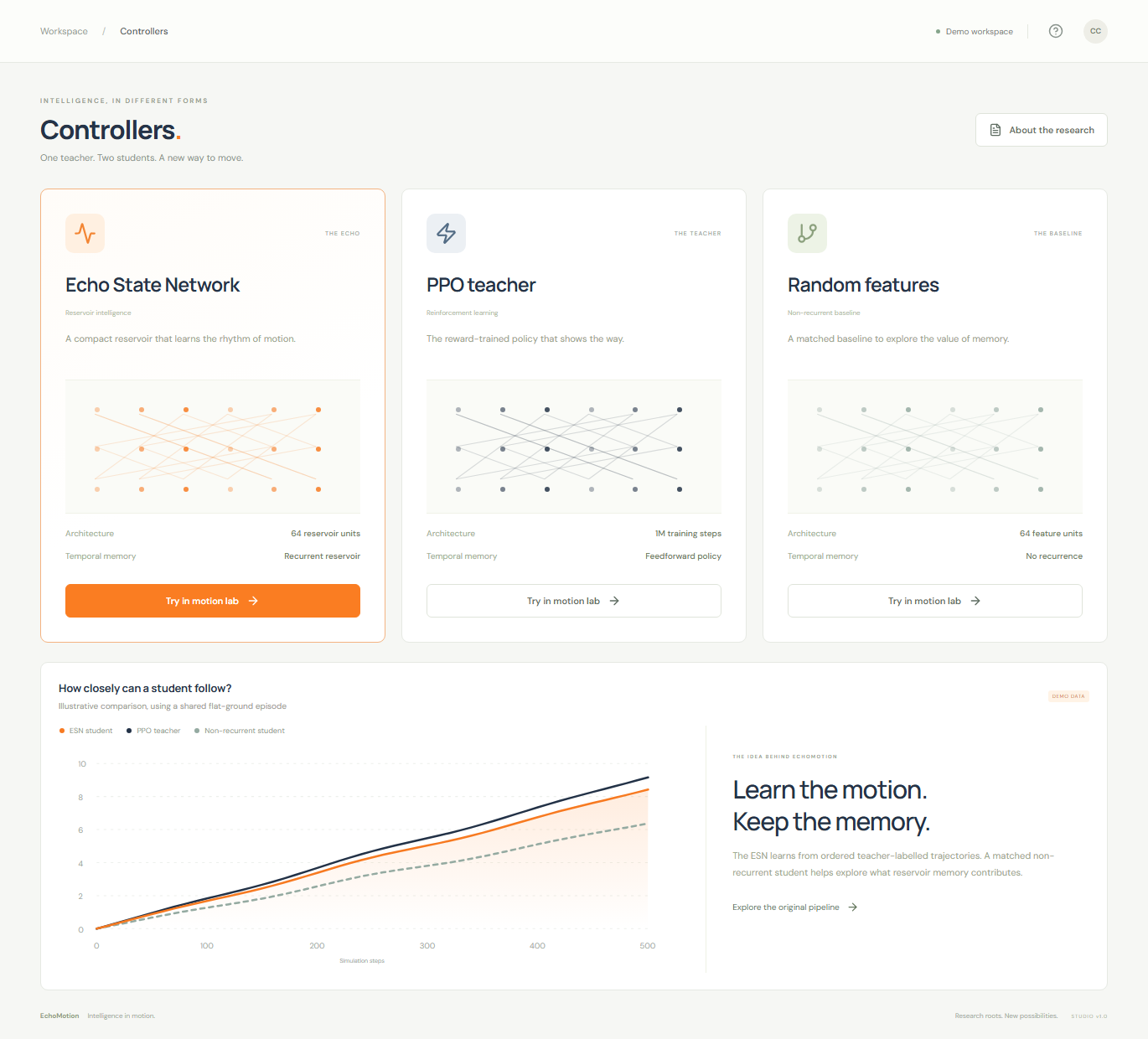
The controller view places three approaches beside one another: the PPO teacher, the Echo State Network student and a non-recurrent random-features baseline. Architecture and temporal-memory labels explain the distinction, while the shared comparison view keeps the movement context consistent. The ESN presentation centres on learning from ordered teacher-labelled trajectories; the matched non-recurrent student provides a way to discuss what the reservoir's memory contributes. Example curves illustrate that comparison without replacing the separately qualified timing result.
04 / Experiment context
Give a comparison a place to be understood.
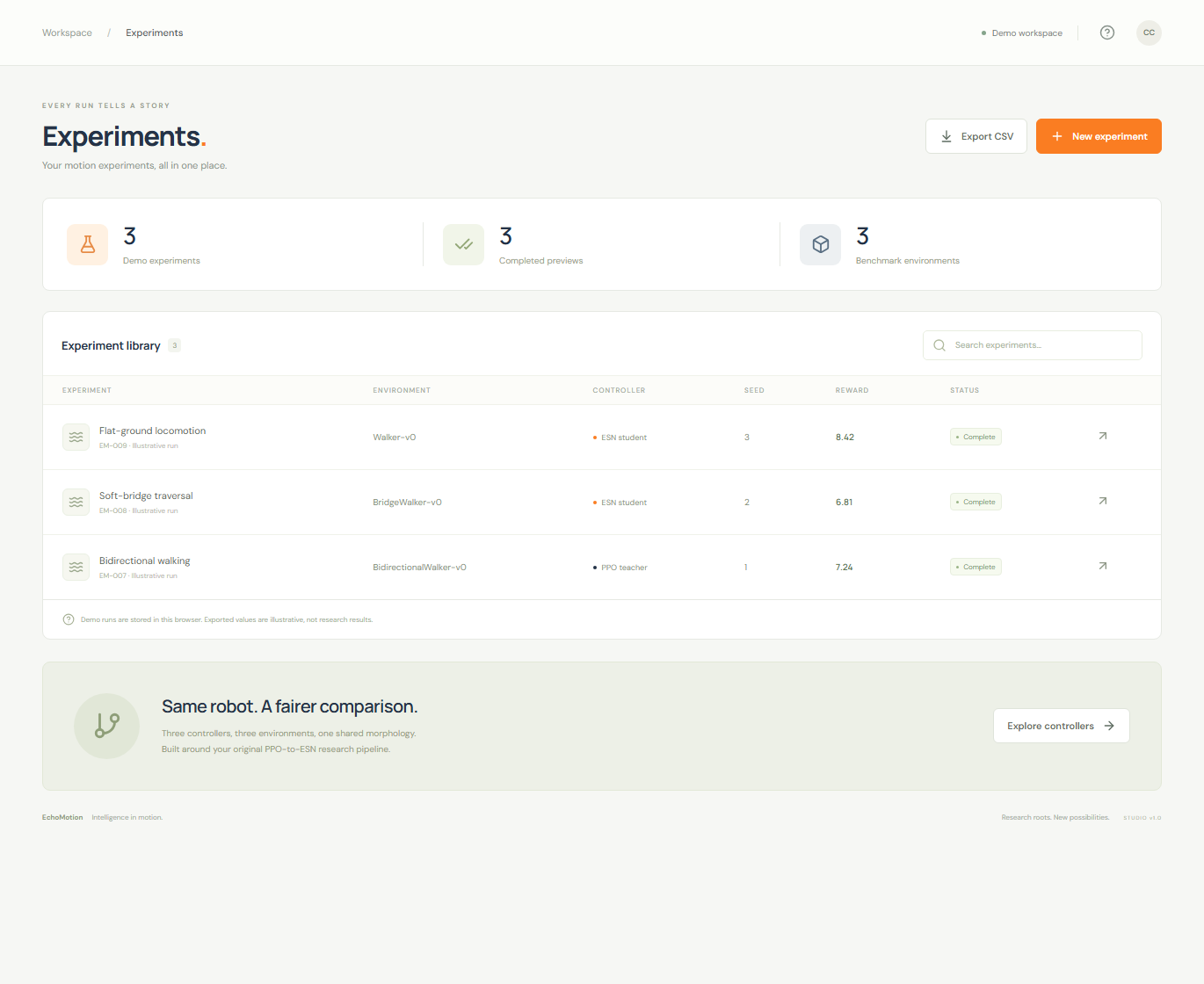
The experiment library records the information that gives a run context: its name, environment, controller, seed, reward and status. A search field helps make the collection navigable, while summary counts introduce the example runs and the environments represented. The table allows a reader to compare the setup as well as the displayed result, instead of judging each experiment from a headline number alone.
The demonstration distinguishes flat-ground locomotion, soft-bridge traversal and bidirectional walking. Keeping those situations associated with their controller and seed makes the presentation more useful than an undifferentiated list of scores. The interface also labels browser-stored demo runs and illustrative exported values. That separation gives the research story room to be detailed while retaining a clear boundary between an explanatory application and the experimental evidence behind a specific result.
05 / A technical story
Make the subject visible without overstating the result.
The mobile overview and motion-lab captures carry the same workspace into a narrow-screen presentation. The robot, the control context and the explanation of the research remain recognisable, while navigation and working areas adapt to the available space. A technical subject should still have an understandable entry point when a visitor is reviewing the work away from a desktop.
The result is a portfolio project with two connected contributions: an investigation into policy transfer and a considered interface for explaining its ideas. EchoMotion brings Python-based simulation, learned behaviour, controller comparison and technical communication into the Cosilan collection. It demonstrates the care needed to keep a visual explanation engaging while describing a measured result precisely: what was compared, which part of the work was timed and how far the conclusion can reasonably extend.