

The product, in depth
The whole story behind your social presence.
Social Flow is being built for the work that happens around every social post: the idea, the brief, the image, the caption, the review, the timing, the conversation, and the result. Its vision brings those steps into one connected workspace, so the people managing a brand can see the bigger picture without losing the detail.
Plan campaigns on a shared calendar. Tailor content to different platforms. Preview posts in context. Organise brand assets, collect feedback, manage profiles and company Pages, and understand how content performs. For an individual creator, that means a clearer daily routine. For a team or agency, it means shared ownership, cleaner handovers, and a more consistent way to work across brands.
Social Flow's direction is simple: give good ideas more room, and make the process around them easier to follow.
01 / A shared starting point
A home for the work behind your social presence
A social presence is built through hundreds of small decisions. What should you share next? Which channel suits the idea? Is the right image ready? Who needs to review the caption? What happens when somebody asks a question? Did the campaign reach the people you hoped it would?
When that work is spread across spreadsheets, chat threads, cloud folders, platform tabs, and last-minute reminders, the process becomes harder to see. Ideas get separated from their context. Feedback arrives in the wrong place. People spend time checking what happened instead of deciding what should happen next.
Social Flow's full product vision brings that work into a shared home. Planning, creation, publishing, conversations, collaboration, and reporting belong to the same story. The aim is to make that story easier to follow, whether you manage one brand or several.
Start your day with a clearer picture
The dashboard is designed as a practical starting point. See what is coming up, what is waiting for review, what your community is doing, and how your recent content is performing. The information should help you decide where to spend your attention, rather than becoming another wall of numbers to work through.
Scheduled content sits alongside useful performance trends and recent team activity. A post approved this morning, a campaign moving into its next stage, a growing conversation, or a change in engagement should all have a clear place in the wider picture.
For a solo creator, that view can become a simple daily rhythm. For a team, it can become a shared reference point: the same priorities, the same plan, and a clearer understanding of what needs to happen next.
02 / Planning & publishing
Plan the story, not just the next post
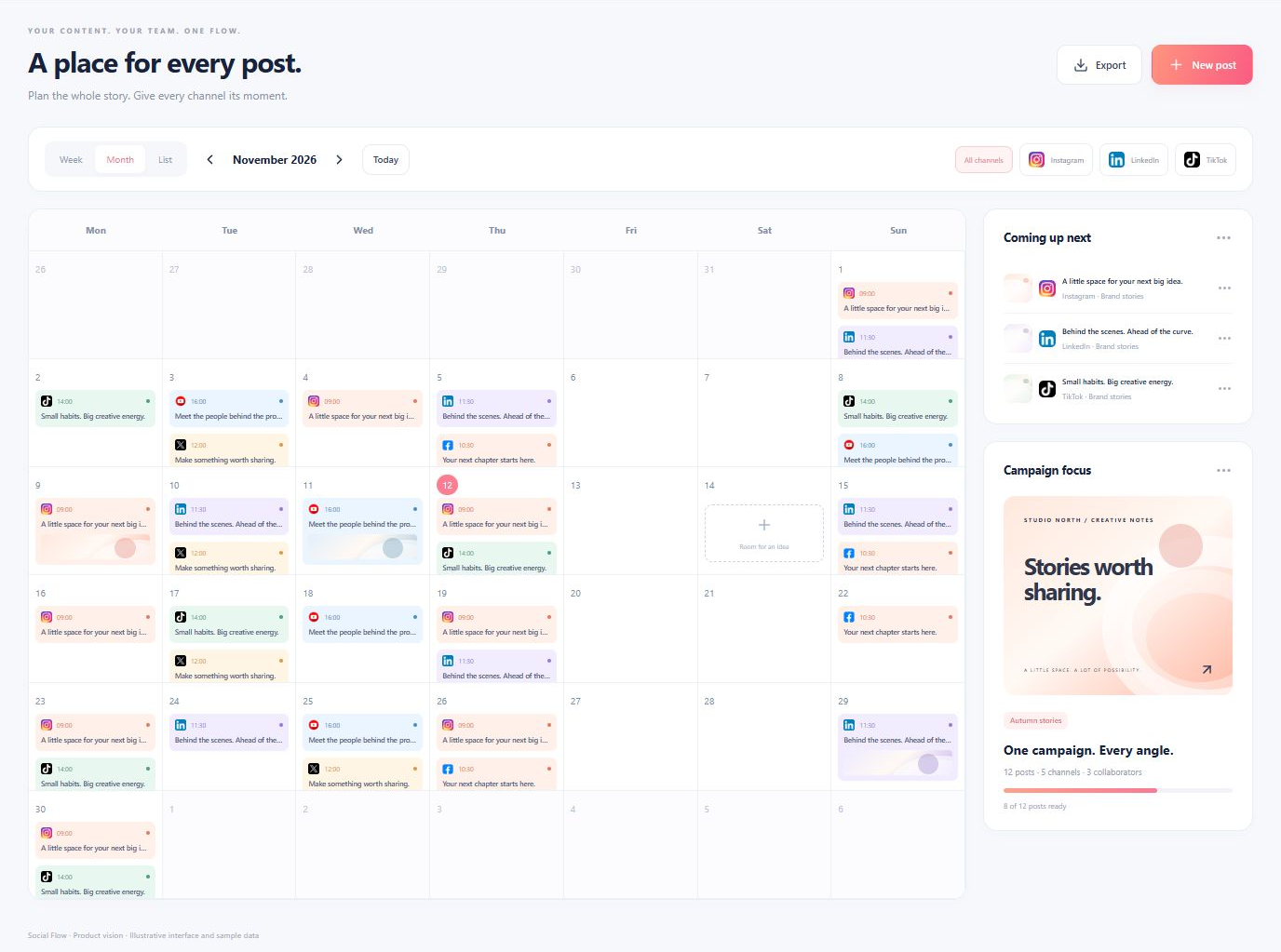
The content calendar is at the centre of the Social Flow vision. It is a place to see how individual ideas become a steady, purposeful social presence. Bring launches, seasonal moments, recurring series, educational content, behind-the-scenes stories, and everyday updates into one visual plan.
Move between a broad monthly view and the detail of a particular week or publishing queue. Look across channels, or focus on one platform, campaign, account, or stage of work. Spot a quiet stretch before it becomes a last-minute scramble. Notice when several important messages are competing for the same day.
A useful calendar should also make room for change. Campaign dates shift, assets arrive later than expected, and a timely idea can deserve a place in the plan. Social Flow is designed around a calendar that helps the team adapt while keeping the wider story visible.
Schedule with purpose, and keep the queue understandable
Scheduling should help a team prepare ahead without losing awareness of what will happen. Social Flow's publishing direction combines the selected account, the final content, its attachments, the intended time, and its approval state in a process people can review.
Build a queue around your campaign plan. Check the date and timezone. Give important content a final look before it is committed. See the difference between an idea, a saved draft, content waiting for approval, and a post ready for publication.
A useful publishing system also needs understandable status information. If a connection needs attention or a platform does not accept a request, the team needs a clear next step. The aim is a publishing experience that helps people stay informed, particularly when they are managing a busy calendar across several channels.
03 / Creating for each channel
Create once, then give each channel its own voice
Different platforms invite different kinds of content. A thoughtful professional update, a visual carousel, a short video, and a concise community post can start from the same idea without needing the same treatment.
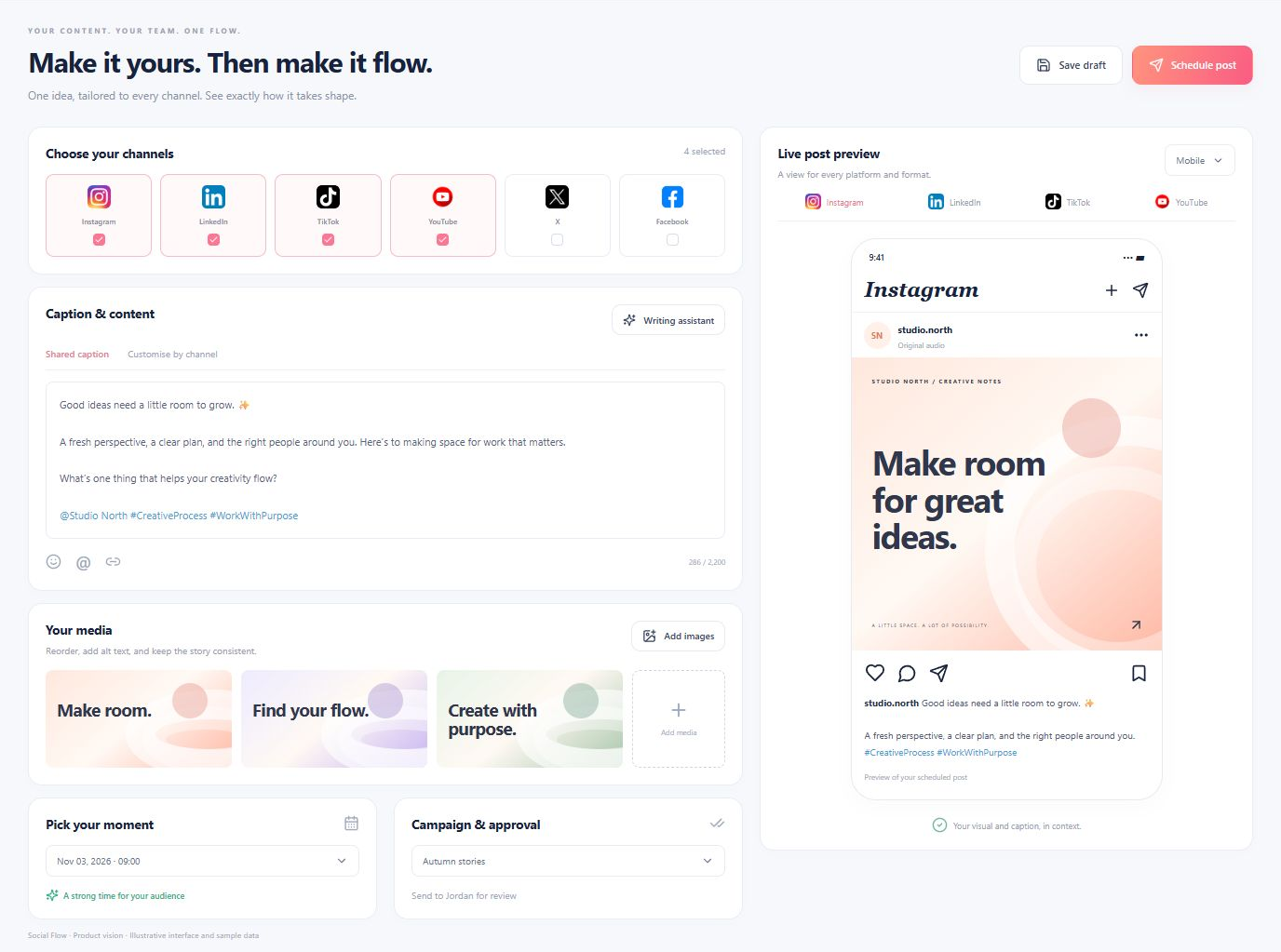
The multi-channel composer is designed to keep that relationship intact. Begin with the shared message, then shape the wording, formatting, media, and publishing choices for the channels you select. Keep the campaign recognisable while giving each post enough attention to feel at home where it appears.
That approach is especially useful when several people work on the same content. A shared starting point helps the team agree on the message. Channel-specific versions give writers, designers, and social managers space to make the final expression appropriate. The goal is a connected workflow that respects the differences between platforms.
See your content in context before it goes live
A caption can feel right in an editor and look different when it sits inside a feed. The relationship between the first line, the image, the author identity, the visible text, and the format can change how a post comes across.
Social Flow's preview experience is designed to make those decisions easier to review. Look at content through a platform-specific layout, switch between relevant formats, and consider how it appears on a smaller screen. Check whether the visual supports the message. See whether the opening line does enough work. Give reviewers a clearer view of the finished idea.
Previews are a planning aid, rather than a promise that every platform will render every detail identically. The intention is to reduce guesswork and make review more concrete, with the context people need to give useful feedback.
Keep your voice while getting a little help
Sometimes the hardest part of a post is the first sentence. Sometimes a strong draft needs a shorter version, a different opening, or a tone that feels more appropriate for another channel.
The writing-assistance direction for Social Flow is built around those practical moments. Explore an alternative hook, reshape a paragraph, work through a few caption options, or adapt an existing message for a different audience. Keep the assistant close to the content and the context of the campaign.
The person creating the post remains responsible for its voice, accuracy, relevance, and final publication. The aim is useful support for creative work - a way to get unstuck or consider another version while keeping the decisions with the team.
04 / Visual assets
Make visual content part of the plan
Images, short-form video, longer video, carousels, and documents each have a role in a modern social strategy. The long-term Social Flow direction gives these formats a connected place in content creation, with the options and validation appropriate to each supported channel.
Bring the media together with the caption and campaign, instead of treating the asset as a separate task to find later. Review attachment order, consider accessibility text, and check that the format fits the platform and account being used. Keep variations close to the content they support.
This is about more than attaching a file. It is about making the creative work easier to organise and easier to understand, so a strong visual has the context it needs to become a strong post.
Build a media library your team can actually use
A library becomes valuable when people can find the right asset at the right moment. Social Flow's media-library vision brings campaign visuals, reusable brand assets, videos, and supporting documents into one organised workspace.
Group material into collections that make sense for your brand: a launch, an ongoing series, a seasonal campaign, a visual identity, or a particular content theme. Give files useful names. Keep the assets that belong together close to each other. Make it easier to reuse good work without searching through a trail of old messages and downloads.
For a growing team, that shared library helps reduce ambiguity. People can see which visual is intended for the campaign and which collection it belongs to. For an agency, workspace boundaries help keep one client's assets separate from another's.
05 / Campaign development
Give every campaign a clear route forward
Good ideas need a place before they are ready for a calendar. A campaign board is designed to hold the work in progress: the early thought, the content brief, the draft caption, the visual direction, and the next decision.
Move content through stages that reflect how the team works, such as ideas, creation, internal review, client approval, and ready to publish. Give the task an owner, connect it to a campaign, and keep the deadline visible. See where work is gathering and where a small decision could help it move forward.
The value is in the connection between those stages. An approved draft should not lose its brief when it becomes a scheduled post. A campaign should retain its purpose as it moves from planning to creation, publishing, and reporting.
06 / People & review
Bring feedback closer to the content
Review works better when people are looking at the same thing. A suggestion in a chat thread can become confusing when there are several caption versions, multiple visuals, and a changing schedule.
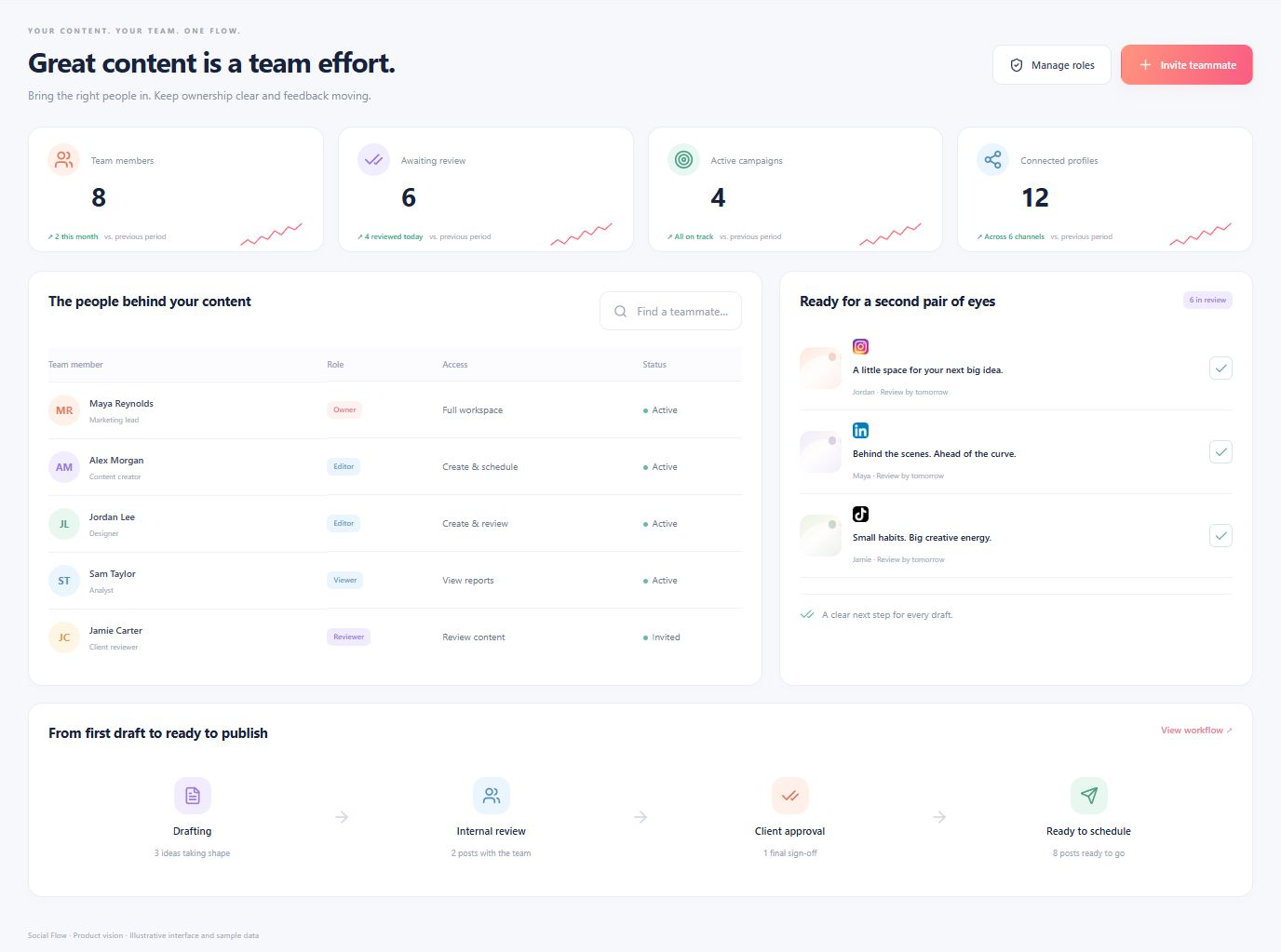
Social Flow's collaboration vision brings feedback, internal notes, ownership, and approval status into the content workflow. Writers and designers can work from the same context. Managers can see what is ready for a decision. Reviewers can focus on the material they are responsible for, with a clearer understanding of what happens after they respond.
For teams that work with clients, that can create a more structured review process. For in-house teams, it can make everyday handovers clearer. The goal is a practical way to gather input and reach a decision while keeping the content itself easy to follow.
Give people the access their work needs
Not everyone in a workspace has the same role. Some people set up the brand and manage the team. Others write content, design assets, review work, or study performance. A useful shared workspace recognises those differences.
Social Flow is designed around clear workspace membership and role-based access. Bring teammates into the relevant brand environment and give them a level of access that fits their responsibilities. Keep ownership visible and make it easier to understand who can create, review, schedule, or manage the work.
As teams grow, those distinctions become more useful. A new collaborator should be able to join the process without everybody losing track of who is responsible. The workspace should help the team work together while keeping its boundaries understandable.
07 / Brands & workspaces
Manage several profiles and Pages with less switching
A brand can have several social identities. A business may manage company Pages alongside personal professional profiles. A creator may run several channels. An agency may need separate spaces for different clients, each with its own content, people, accounts, and reporting.
The Social Flow vision brings those relationships into a workspace model. Keep the profiles and Pages for a brand together. Make the publishing identity a deliberate choice. Give collaborators a clearer view of the channels they are working on, instead of leaving them to piece the context together from separate accounts and tabs.
The broader multi-channel direction includes Instagram, Facebook, LinkedIn, TikTok, YouTube, X, and room for additional networks as the product develops. The available formats, account types, interactions, and data will depend on what each platform permits and what is supported in a particular release.
08 / Community conversations
Make room for the conversation after the post
Publishing is the beginning of an interaction, not the end of the work. Questions, comments, replies, and mentions can tell you what people care about and where your team can be useful.
The shared-inbox vision gives those conversations a place alongside the wider content workflow. Review incoming interactions with the original post and relevant context nearby. Assign a conversation to the right teammate. Use internal notes to keep the handover clear, and distinguish those notes from the reply intended for your audience.
For a small team, that can make it easier to share responsibility. For a larger team, it can help prevent an important conversation from becoming everybody's task and nobody's task. Coverage will follow the interaction types and access made available by each supported platform.
09 / Performance & audience
Understand performance without losing the meaning
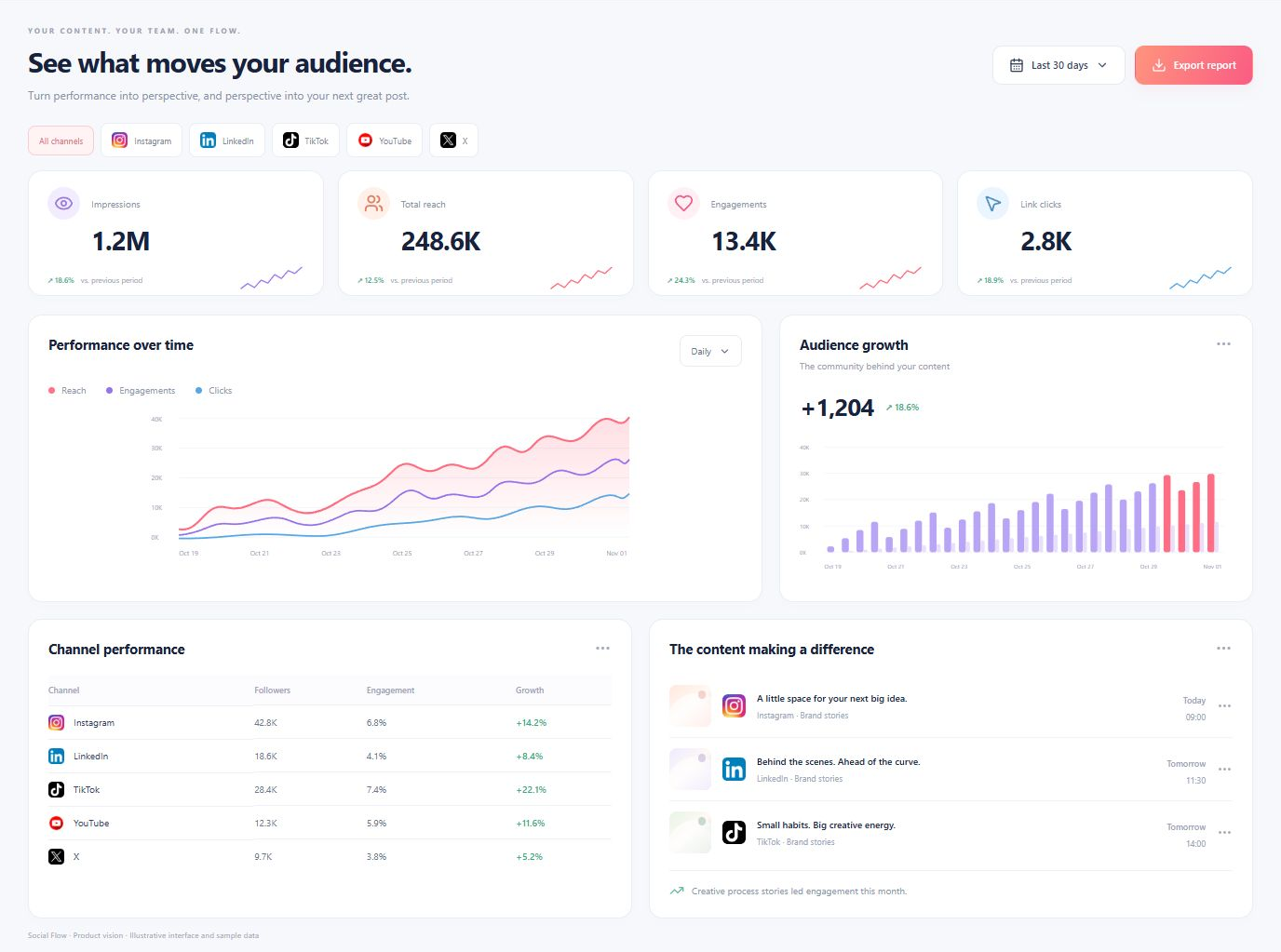
Numbers become more useful when they help you make a decision. Social Flow's analytics vision brings content and account performance into a clearer view, with the context needed to understand what changed and why it might matter.
Explore reach, impressions, engagement, clicks, and audience growth where those metrics are available. Compare time periods, look at individual channels, and connect strong results with the content behind them. See whether a recurring series is finding an audience or a campaign is reaching the people it was intended for.
Different platforms define and expose metrics differently. A thoughtful reporting experience should preserve those distinctions, show where data comes from, and avoid presenting unavailable information as a meaningful result. The direction is practical insight: enough clarity to ask better questions and plan the next piece of work.
Get to know the community behind the numbers
Audience insight adds another dimension to content planning. Beyond an overall follower count, a team may want to understand patterns in growth, geography, interests, activity, and the kinds of content that invite a response.
Social Flow's audience vision connects those signals with the editorial process. Use the available information to consider which themes deserve more attention, when a community is most active, or how a brand's audience is changing over time.
Those insights should support judgement, not replace it. A good idea can matter even when it does not fit a previous pattern. The purpose is to give creators and social teams a more informed starting point, with useful boundaries around what the data can and cannot tell them.
10 / A considered experience
A workspace designed to feel considered
Social Flow's visual direction uses clear navigation, generous spacing, soft backgrounds, warm coral accents, and a consistent card system. The intention is a product that feels approachable when the work is busy and understandable when a new teammate joins.
The same consideration runs through the workflow. A status should have a clear meaning. A workspace switch should show which brand you are working on. A preview should make a review easier. Information should stay available as people move between related parts of the product.
Desktop views are designed for the broader planning and reporting picture, while smaller-screen layouts focus on the tasks that matter in the moment. The goal is continuity: recognisable content, familiar controls, and a clear place to pick up the work again.
One connected process, with room to grow
The full potential of Social Flow comes from the relationship between its parts. An idea becomes a campaign task. A task becomes a draft. The draft receives feedback, takes its place in a calendar, reaches an audience, starts a conversation, and adds something useful to the next planning decision.
Keeping that process connected can help people spend less attention rebuilding context and more attention on the work itself. It can make a small team's routine clearer and give a larger team a shared way to coordinate its social presence.
That is the product direction behind Social Flow: a place where content, people, channels, and learning can move together, with enough structure to stay organised and enough room to keep creating.